
Bottlenecks that paralyse agile software development
Beyond development activities and developer skills

In my coaching and consulting engagements, I often get inquiries from leadership expressing concerns about their team's ability to deliver value faster and seeking ways to build high performing agile teams.
In the past year, I've studied multiple teams, focusing on product management practices, technical methodologies, workflow dynamics, and team interactions.
When evaluating a team’s ability to continuously deliver value, I adopt an approach centred on identifying bottlenecks that hinder the flow of valuable work. Interestingly, I've discovered that these bottlenecks aren't always related to development work or developer skills.
In this post, I am sharing some indicators that individually or in combination may lead to bottlenecks that constrain the flow of work.
Upfront design phases before development
Some teams strive to minimise risks by meticulously planning every aspect of their projects. They invest significant time in architecture, design, and workflow discussions to gather as much information as possible, aiming to anticipate and mitigate potential issues. While this approach may seem prudent, it may also increase the risk of failure with lack of experimentation and feedback loops.
It may sound very waterfall-like, but for many teams that I have interacted with, agile software development (or I should rather say, their “sprints”) only begins post such upfront design phases. In such cases, agility is merely a label applied to the team structure, rather than being fully embraced in practice.
The prolonged design phases hamper transparency with leadership making them nervous about the progress. It also tends to accumulate a lot of work for development leading to All or nothing release plans and Silos within the team.
All or nothing release plans
Release plans that consist of bundles of features (or initiatives) that must either be released together or wait until the entire batch is completed and tested.
This often results in a backlog of unfinished work, which remains untested post-development because stakeholders prefer to wait until all tasks are completed before testing begins.
Consequently, when testing finally commences and bugs are discovered, it leads to further delays in releases due to time take in bug fixes and re-testing.
The figure below shows the lead time distribution for a team where features spend most of their time in either TODO or DONE (i.e. Development complete and waiting for release) state.
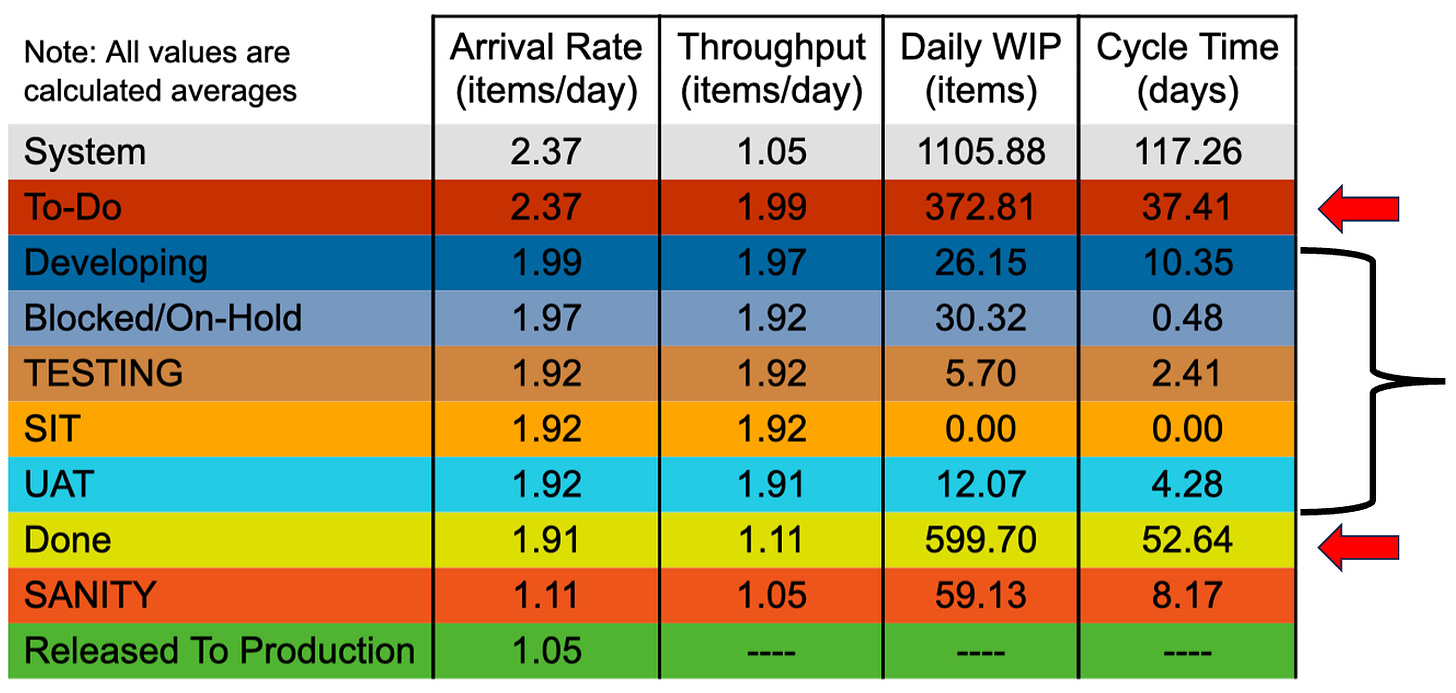
It clearly indicates that while teams may seek to speed up development, the bottleneck in this case is “either at the top or the bottom of the bottle.”
A common reason for such release plans are Upfront design phases and External dependencies
External dependencies
Some teams find themselves blocked by other teams contributing to a larger system in the organisation. These dependencies exist either due to how teams are structured and defined within the organisation, or due to need for integration with third party systems.
The situation may become complicated when inter-dependent teams don’t share common goals and priorities leading to delays.
To mitigate these delays, teams inadvertently introduce overhead in synchronising and aligning with each other, often necessitating Upfront design phases.
It also leads teams to run multiple initiatives in parallel in order to show progress to leadership and keeping people “busy”. However, instead of helping this often leads to creating further bottlenecks in delivery.
Silos within team
Team members are told or themselves exhibit a tendency towards individual ownership of specific components or tasks, leading to a division of work characterised by specialised duties with minimal collaboration or overlap.
Essentially, it creates a scenario akin to multiple teams operating within the larger team structure, each focusing narrowly on their assigned responsibilities without broader engagement or integration with the collective effort.
Such specialisation creates silos leading to planning and execution overheads and process heavy teams.
Lack of focus on good engineering practices
Teams that embrace popular agile frameworks sometimes focus solely on adopting the framework's structural and procedural elements, overlooking the importance of emphasising and practicing the core principles of good software development.
This approach often results in low-quality development, insufficient emphasis on continuous integration, and a reliance on manual, repetitive, error-prone processes. A significant consequence is the gradual degradation of the software system, manifesting in defects, development delays, and ultimately creating bottlenecks in development efforts.
This behavior is frequently driven by stakeholder pressure for accelerated delivery, coupled with the team's reluctance to negotiate on the quality and integrity of product development. However, deferring quality considerations to a later stage substantially amplifies the required effort to bridge the gap. Eventually, these deferred issues resurface, manifesting as technical debt or legacy refactoring projects, which can halt value delivery altogether.
In conclusion, building high performing teams requires a holistic approach and mindset shift that goes beyond concepts, frameworks and terminology. It requires disciplined behaviour, awareness and ability to apply system thinking to visualise end to end delivery flow.
By recognising and addressing such bottlenecks that hamper their ability, teams can unlock their full potential and streamline their workflow.
This is a very grounded and accurate take on why many teams struggle to improve delivery speed despite “doing agile.” I like how you frame the problem through flow and bottlenecks rather than jumping straight to developer productivity or tooling. That lens immediately exposes issues that often stay invisible in sprint metrics.
The point about upfront design phases resonated strongly. Many teams genuinely believe they are reducing risk, but in reality they are just postponing learning. Without fast feedback, design certainty becomes an illusion, and by the time development starts, flexibility is already gone. That naturally feeds into the all or nothing release pattern you describe, where work piles up in DONE but delivers no value.
Your observation about silos within teams is also spot on. Even inside a single squad, specialised ownership quietly recreates mini handoffs and queues. Over time, planning overhead grows, collaboration drops, and flow slows down, even though everyone appears busy.
What ties this all together for me is your emphasis on systems thinking. None of these bottlenecks exist in isolation, and fixing one without addressing the others rarely works. This is also where lightweight quality and visibility practices help. Having a shared, transparent way to track scenarios, risks, and readiness across roles can reduce waiting states and surface issues earlier. Simple tools like Tuskr (https://tuskr.app/) can support this by keeping quality conversations close to the work rather than pushing them to the end.